
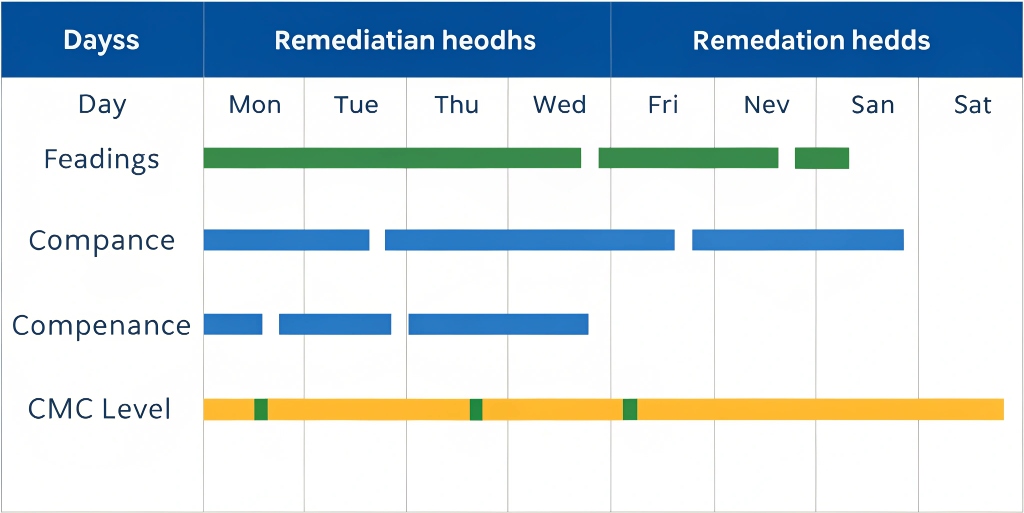
Security gaps don’t disappear overnight. But if you’ve gone through a CMMC Level 2 assessment and come out with a few red flags, you’re not out of the game—you’re on a clock. Organizations get up to 180 days to resolve non-compliant findings, and what you do in the first 60 days matters more than most realize.
Initial 60-Day Remediation Steps Following CMMC Level 2 Assessment
The first 60 days after a CMMC Level 2 assessment are not for planning—they’re for doing. As soon as the findings are delivered, your team should begin tackling the deficiencies that impact your ability to protect Controlled Unclassified Information (CUI). This period is focused on high-priority actions like patching critical vulnerabilities, restricting unauthorized access, and establishing documented procedures where they’re missing. This isn’t the time for theory. Federal contract eligibility hinges on showing progress from day one.
Organizations working with a CMMC RPO are better equipped to act quickly in this window. From clarifying assessment results to helping implement required controls, their guidance can mean the difference between making or missing your milestones. The goal is to close urgent gaps quickly while setting the stage for longer-term activities that align with broader CMMC compliance requirements. At this stage, even if every control isn’t perfect, proof of effort and documented progress will count heavily.
Critical Milestones in the 180-Day CMMC Level 2 Compliance Window
After the first 60 days, things don’t slow down—they ramp up. The 180-day window exists so organizations can fully resolve all identified gaps that prevented full compliance during the assessment. This means not just applying quick fixes, but confirming that implemented changes are functioning effectively. Organizations must show that the controls listed under the CMMC level 2 requirements are operating consistently, monitored regularly, and producing evidence of effectiveness.
Milestones within this time frame should be clearly tracked. For example, by day 90, most technical control remediations should be completed. By day 120, ongoing assessments and internal audits should be in motion to confirm success. And by day 150, any lingering documentation updates or staff training should be finalized. A CMMC RPO or c3pao can help align your project plan to match the level of maturity expected in a formal review or re-assessment.
Essential Documentation Updates Within the 60-Day Remediation Period
Updating documentation might sound like a side task, but under CMMC level 2 compliance, it’s absolutely foundational. During the first 60 days, system security plans (SSPs), incident response policies, access control procedures, and user training protocols need to reflect current reality—not outdated best guesses. Auditors want to see that what’s on paper matches what’s implemented.
More importantly, documentation must include evidence of execution. For example, it’s not enough to write that multi-factor authentication is in place—it needs to be enabled, tested, and monitored. This level of detail can catch organizations off guard if they treat the 60-day window like a paper exercise. With the right CMMC RPO assisting, these updates become more accurate, audit-ready, and harder to dispute during final evaluations.
Reasons Organizations Typically Miss 180-Day Compliance Deadlines
One common pitfall is assuming there’s more time than there really is. The 180-day window includes every workday, weekend, and holiday. Procrastination or lack of ownership causes the most delays, especially if remediation tasks span departments without clear accountability. Failing to prioritize security gaps linked to technical debt also slows progress.
Another issue: underestimating the documentation and evidence collection required. CMMC compliance requirements go beyond simply applying fixes. You need proof—logs, training records, test results, and timelines. Without a clear structure and coordination between internal teams and an experienced CMMC RPO, organizations often run out of time before realizing how much is still unfinished.
Key Indicators of Progress at the Midpoint of Your 180-Day Timeline
At the 90-day mark, the halfway point, decision-makers should review progress against a formal remediation plan. If core controls from the CMMC level 2 requirements still haven’t been addressed, that’s a red flag. At this stage, technical remediations should be mostly completed, and attention should shift toward validating control effectiveness and collecting artifacts.
Communication across your team should also be frequent and transparent. If stakeholders can’t clearly explain which issues are fixed, what remains pending, and where documentation stands, the risk of missing your window increases dramatically. Involving a c3pao earlier in the process or coordinating with a CMMC RPO to review progress helps keep everything on track.
What Specific Actions Define Success in the First 60 Days of CMMC Remediation
Success in the first 60 days is not just about speed—it’s about precision. Teams that perform a thorough gap analysis, assign tasks by control family, and begin executing immediately are set up for smoother remediation. Policies should be drafted or updated with input from technical staff, not just copied from templates.
Security control implementation should begin alongside documentation updates. MFA, log monitoring, incident response drills, and access reviews are examples of controls that can be implemented fast but require testing and evidence. Demonstrating clear action during this period builds credibility and momentum that will carry you through the rest of the timeline.
Methods to Validate Control Effectiveness Before the 180-Day Cutoff
Control effectiveness must be verified before the clock runs out. That means testing—either internally or through third-party tools—and capturing evidence such as screenshots, configuration exports, or access logs. It’s not enough to say a process exists; auditors and assessors need to see it in action.
Internal audits, tabletop exercises, and policy reviews are valuable tools for this validation. Working closely with a CMMC RPO during this final phase can surface any gaps that still need to be closed. In many cases, a second set of eyes can catch misalignments before they become failures in a c3pao’s formal re-evaluation. Control maturity and readiness are key drivers of passing within the 180-day window.
About the Author


